The Ultimate Comparison: Salesforce Sales Cloud vs DealDrive for Small Business Sales Teams
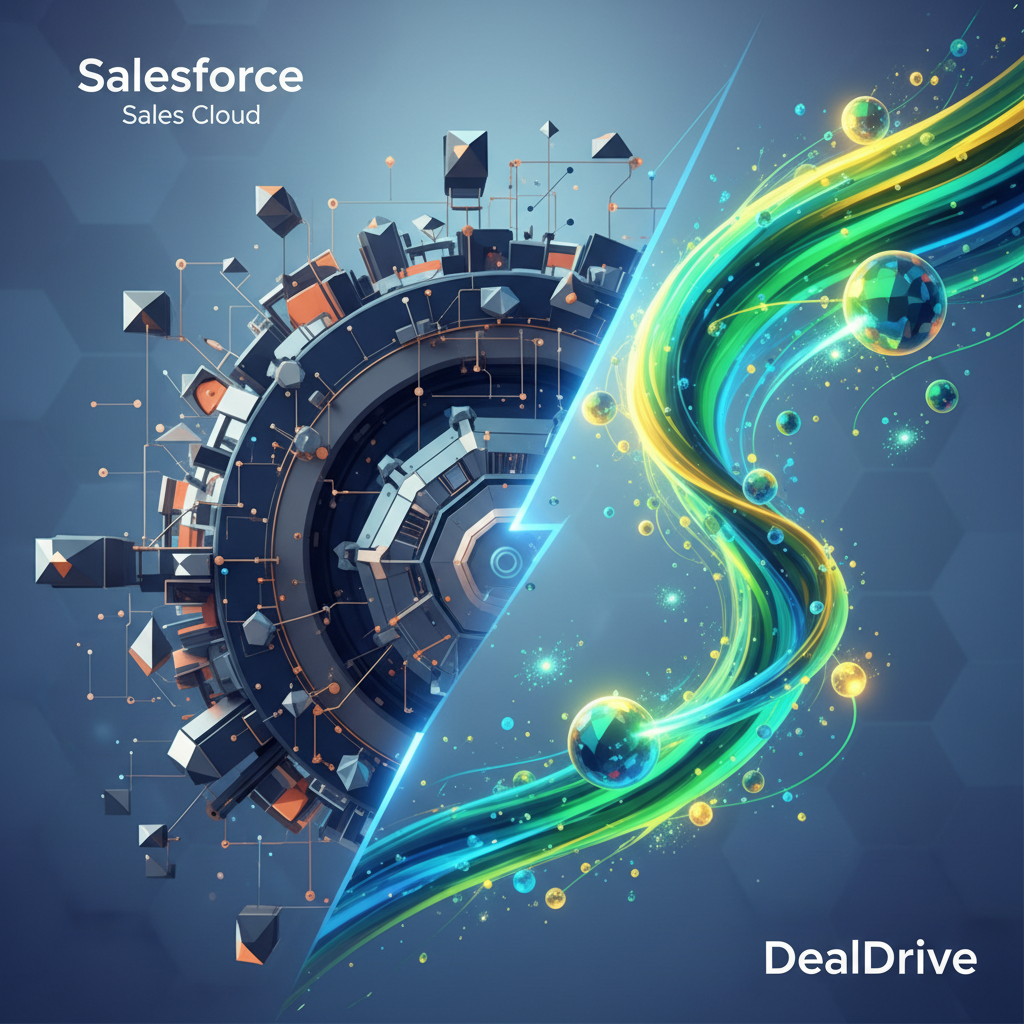
Choosing the right Customer Relationship Management (CRM) platform is a defining moment for any small business aiming to scale its sales operations. In this ultimate comparison, we break down the long-standing industry titan, Salesforce Sales Cloud (SFDC), against the next-generation, AI-first platform, DealDrive, to determine which offers the best value for modern sales teams.
Understanding the Evolution from Traditional CRM to Agentic AI
For decades, CRM systems like Salesforce have served as sophisticated digital filing cabinets, requiring manual data entry and complex administrative oversight. While SFDC is undeniably powerful, its architecture was built for an era where humans did all the heavy lifting, using the software merely as a record-keeping tool.
Enter DealDrive, a platform purposefully engineered around Agentic AI. Unlike traditional tools that wait for user input, an agentic system proactively executes tasks, reasons through sales hurdles, and manages workflows independently. This shift represent a fundamental change in how small businesses approach their sales pipeline management.
Small businesses today often lack the massive operations teams required to maintain a complex Salesforce instance. This creates a growing demand for platforms that offer autonomous capabilities and a lower total cost of ownership (TCO) without sacrificing enterprise-grade intelligence.
Salesforce Sales Cloud: The Established Powerhouse
Salesforce, often referred to by its stock ticker SFDC, is the global leader in the CRM space. It offers an incredibly vast ecosystem of integrations, third-party apps via the AppExchange, and a degree of customizability that is virtually limitless. For a small business with a dedicated Salesforce Administrator, the platform can be molded to fit any imaginable business process.
However, that power comes with significant architectural complexity. Implementing Salesforce often requires months of consulting and significant financial investment beyond the per-user license fee. For a small team, the "Salesforce Tax"—the hidden costs of maintenance and training—can quickly outweigh the benefits of its feature density.
Key highlights of the Salesforce experience include:
- Unrivaled Integration Library: Connects with almost every enterprise tool on the market today.
- Einstein AI: A suite of predictive tools designed to provide lead scoring and forecasting insights.
- Extensive Customization: Using Apex code and Visualforce, developers can build entirely proprietary interfaces.
- Global Community: A massive talent pool of certified professionals and Trailhead learning resources.
The Small Business Challenge with SFDC
While SFDC offers a "Starter" edition for small teams, many users find they quickly outgrow its limitations, forced into higher-tier plans like Enterprise or Professional to access essential automation features. This vertical scaling can lead to budget fatigue for growing startups that need to remain lean.
DealDrive: The Rise of the Agentic CRM
DealDrive represents the "Agentic" revolution in CRM technology. Rather than just being a place to store contacts, DealDrive acts as a virtual sales assistant that works alongside your team. Its core philosophy is to remove the "grunt work" of sales—data entry, follow-up scheduling, and lead research—allowing humans to focus on closing deals.
The Agentic AI capabilities of DealDrive allow it to observe interactions, suggest the next best action, and even draft personalized outreach based on the specific context of a lead's behavior. This isn't just basic automation; it is autonomous reasoning applied to the sales cycle.
"The future of sales isn't just about having better data; it's about having software that knows what to do with that data without being told every single step."
For small businesses, DealDrive provides a significant competitive advantage by offering high-level intelligence that usually requires a full-time sales ops department. The platform is designed to be intuitive out-of-the-box, drastically reducing the time-to-value compared to traditional enterprise systems.
Comparing Features: Automation vs. Autonomy
When comparing SFDC and DealDrive, it is helpful to distinguish between automation (rules-based triggers) and autonomy (goal-oriented AI). Salesforce excels at the former through its robust Flow Builder, while DealDrive is a pioneer in the latter.
Workflow Management and Ease of Use
In Salesforce, setting up a new workflow often involves complex logic gates and testing. In contrast, DealDrive utilizes natural language processing and agentic workflows. Users can describe the outcome they want, and the AI helps configure the path to get there. This democratization of technology is vital for small teams who cannot afford specialized IT support.
Data Integrity and Enrichment
One of the biggest pain points in any CRM is "dirty data." SFDC relies heavily on users to keep records updated, often resulting in outdated phone numbers and dead-end leads. DealDrive leverages its agentic foundation to auto-enrich records in real-time, scanning the web and social signals to ensure your sales team always has the most current information available.
Key Differences at a Glance:
- Configuration: SFDC requires an admin; DealDrive is self-serve and AI-guided.
- Intelligence: SFDC uses predictive modeling; DealDrive uses agentic reasoning.
- Speed: DealDrive updates in real-time based on agentic triggers; SFDC updates based on user clicks.
Cost Effectiveness and Total Cost of Ownership (TCO)
For small businesses, every dollar must be accounted for. The cost effectiveness of a CRM isn't just the monthly bill; it's the cost of lost productivity during setup and the cost of employees spending hours on data entry instead of selling.
- Licensing Fees: While Salesforce has a low entry point, the costs escalate quickly as you add "add-ons" for AI, extra storage, and advanced reporting.
- Implementation Costs: Professional services for SFDC can cost 2x to 3x the annual license fee. DealDrive is designed for rapid deployment, often taking hours instead of weeks.
- Operating Costs: DealDrive’s agentic capabilities reduce the need for a dedicated Sales Ops hire, potentially saving a small business $80k-$120k per year in salary costs.
- Training: The steep learning curve of Salesforce often leads to low adoption rates. DealDrive’s modern, consumer-grade UI ensures that sales reps actually want to use the tool.
By prioritizing efficiency through AI, DealDrive offers a transparent pricing model that aligns with the growth trajectory of small sales teams, ensuring they never pay for "shelfware" they don't use.
The Agentic Advantage: Why It Matters for Small Teams
Small teams often struggle with bandwidth. A single sales rep might be managing 50+ active opportunities. In a traditional SFDC environment, that rep is constantly clicking through tabs to update statuses. In the Agentic CRM model, the software identifies that a prospect has engaged with a proposal and proactively alerts the rep with a suggested response and the updated deal stage.
This proactive assistance is the "secret sauce" of DealDrive. It transforms the CRM from a passive database into an active participant in the sales process. This level of agentic intelligence levels the playing field, allowing a 5-person team to operate with the sophistication and output of a 50-person organization.
Furthermore, DealDrive integrates agentic multi-channel outreach directly into the core platform. Unlike Salesforce, which often requires a separate purchase of Salesloft or Outreach.io to handle sequences effectively, DealDrive synthesizes these functions into a single, cohesive experience.
Comparing the User Experience (UX)
The Salesforce user interface (Lightning) is a massive improvement over its "Classic" predecessor, yet it remains cluttered with legacy components. DealDrive offers a streamlined, "mobile-first" philosophy that feels more like a modern productivity tool than a 90s enterprise application. In a world where employee experience directly correlates with retention, the tool your team uses every day matters immensely.
Integration and Ecosystem
It is important to acknowledge that Salesforce has an unmatched ecosystem. If your business relies on highly niche industry software, SFDC likely has a pre-built connector for it. This is the primary reason large corporations remain tethered to the platform.
However, DealDrive has built its architecture on modern APIs, making it incredibly easy to connect with the tools small businesses actually use: Slack, Zoom, Google Workspace, and various marketing automation platforms. By focusing on high-impact integrations, DealDrive provides a "just works" experience without the bloat of thousands of irrelevant apps.
"Integration shouldn't require a weekend of coding. It should be as simple as an Oauth handshake, and that's where modern platforms like DealDrive are winning."
Which Is Right for Your Small Business?
The decision between Salesforce Sales Cloud and DealDrive ultimately comes down to your team's resources and goals. If you have a complex, highly non-standard sales process and the budget to hire a dedicated administrator, Salesforce is a safe, albeit expensive, bet.
However, for the vast majority of small business sales teams, DealDrive is the superior choice. Its focus on Agentic AI, ease of use, and cost-effective scaling makes it the ideal partner for companies that want to grow fast without being bogged down by technical debt.
Consider these final diagnostic questions for your team:
- Do you want your reps spending time typing into a CRM or talking to customers?
- Is your current budget better spent on software licenses or revenue-generating hires?
- Do you need a platform that waits for instructions or one that anticipates your needs?
Conclusion
The SFDC era of the "system of record" is giving way to the DealDrive era of the "system of action." For small businesses, the shift toward Agentic AI isn't just a luxury—it's a necessity for survival in a hyper-competitive market. By choosing a platform that prioritizes autonomous workflows and cost-effective performance, you empower your sales team to reach their full potential.
Ready to see how Agentic AI can transform your sales pipeline? Discover the future of CRM and take your team to the next level with a personalized demo of DealDrive today. Stop managing your CRM and start letting your CRM manage the heavy lifting for you.